What Is Fiberglass? The Science and Strength Behind Your Future Pool
When most people start shopping for a pool, they focus on shape, size, and color. The material the pool is made from often gets treated as an afterthought. But the material is actually the most important decision you'll make, because it determines how long your pool lasts, how much it costs to maintain, how comfortable it feels to swim in, and how well it holds up to decades of Northern California sun, water chemistry, and everyday use. Here's a thorough look at what fiberglass actually is, how it's made, and why it outperforms every other pool material available.
What Fiberglass Actually Is
Fiberglass — short for fiberglass-reinforced plastic, or FRP — is a composite material made from millions of extremely fine glass threads woven together and saturated with a polyester or vinyl ester resin. When the resin cures, it bonds with the glass fibers to create a material that is simultaneously rigid and flexible, extremely strong relative to its weight, and highly resistant to water, chemicals, and temperature changes.
This combination of properties is why fiberglass has become the material of choice across some of the most demanding industries in the world. Bathtubs, showers, and sinks are made from fiberglass because it is waterproof, smooth, and durable. Hot tubs use fiberglass for the same reasons. Multi-million dollar sailing yachts are built from fiberglass because it withstands constant saltwater exposure without corroding, cracking, or degrading. Commercial aircraft and military helicopters incorporate fiberglass components because the material is strong, lightweight, and resistant to stress. High-performance exotic automobiles use fiberglass body panels because they can absorb impact without shattering.
The same properties that make fiberglass exceptional in all of those applications make it exceptional as the material for your in-ground swimming pool.
How a Fiberglass Pool Shell Is Made
Unlike a concrete pool — which is essentially built from scratch in your backyard — a fiberglass pool shell is manufactured in a controlled factory environment using a precision mold. This manufacturing process is one of the key reasons fiberglass pools deliver such consistent quality.
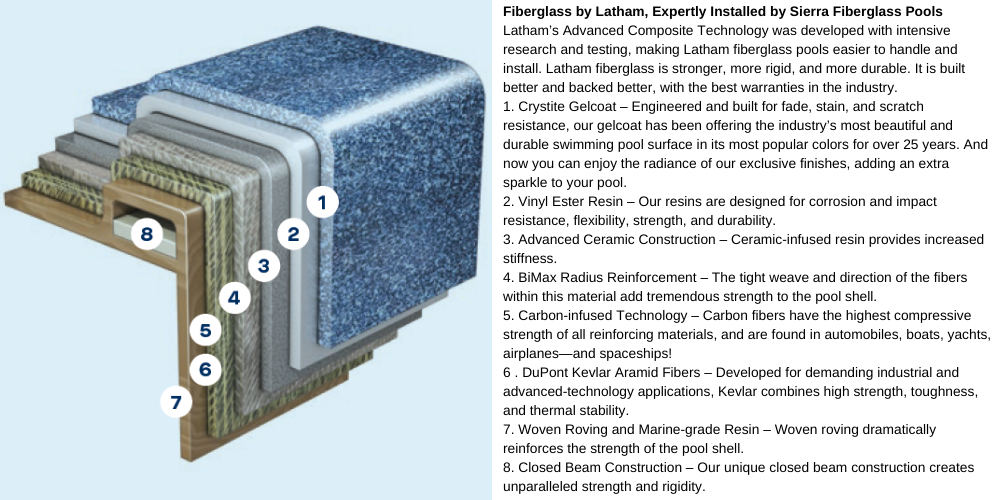
The process begins with a carefully engineered mold in the exact shape and size of the finished pool. Technicians apply multiple layers of material to the mold in a specific sequence. The first layer applied is the gelcoat — a pigmented, UV-resistant surface coating that becomes the interior finish of the pool you'll see and touch. This is the smooth, glossy surface that gives a fiberglass pool its distinctive look and feel.
Behind the gelcoat, technicians apply successive layers of fiberglass mat and woven roving — different configurations of glass fiber — each saturated with resin. These layers build up the structural thickness of the shell, with each layer oriented to add strength in specific directions. More advanced manufacturers like Latham use vinyl ester resin in critical layers rather than standard polyester resin, providing superior resistance to water absorption and osmotic blistering over time.
The entire laminate stack is allowed to cure fully under controlled conditions before the shell is removed from the mold, inspected, and prepared for transport. The result is a single seamless structure with no joints, seams, or connections that could become failure points over time.
The Gelcoat Surface: Why It Matters More Than You'd Think
The gelcoat surface deserves special attention because it is directly responsible for most of the maintenance advantages that fiberglass pools have over concrete.
Concrete is porous. Under a microscope, concrete surfaces are riddled with tiny pits, gaps, and texture where algae and bacteria can attach, take root, and grow. This is why concrete pool owners spend so much time brushing the walls, why their pools consume significantly more chlorine, and why acid washing and eventual replastering are unavoidable parts of concrete pool ownership.
Fiberglass gelcoat is non-porous. The surface is smooth at a microscopic level, giving algae and bacteria no surface texture to grip. They simply cannot attach and grow the way they do on concrete. This is why fiberglass pools require up to 50% fewer chemicals than other pool types to maintain clean, clear water — the surface itself is doing most of the work.
The gelcoat is also chemically inert, meaning it doesn't react with or leach minerals into the pool water the way concrete does. Concrete pools constantly release calcium and alkaline compounds into the water, causing pH to drift upward and demanding more frequent chemical adjustment. A fiberglass pool's gelcoat surface stays out of the chemistry equation entirely, which is why fiberglass pool water tends to stay balanced longer and require less frequent intervention.
Finally, the gelcoat is UV-resistant and color-stable. Latham's gelcoat formulations are engineered to resist the fading and chalking that cheaper pool surfaces can experience after years of intense sun exposure — which is why Latham backs their pools with a lifetime warranty against fading, cracking, and peeling.
Fiberglass vs. Concrete: A Material Comparison
Understanding why fiberglass outperforms concrete becomes clear when you compare the two materials directly.
Concrete is a mixture of cement, sand, and water applied over a steel rebar framework. It is hard and rigid, which means it has essentially no ability to flex. In soil that expands, contracts, or shifts with temperature changes — which describes virtually every residential lot in the Sacramento region — that rigidity can create stress on the structure over time. Concrete pools can develop cracks as the ground around them moves, and those cracks require repair. The porous surface requires acid washing every three to five years and replastering every ten to fifteen years — both significant recurring expenses.
Fiberglass is both strong and slightly flexible. This flex is not a weakness — it is an engineering advantage. When the soil around a fiberglass pool shifts or settles, the shell can absorb that movement without cracking. This is one of the reasons a properly installed Latham fiberglass shell carries a lifetime structural warranty, while concrete pools have no equivalent guarantee against surface degradation.
The weight difference is also significant. A fiberglass pool shell is dramatically lighter than the equivalent volume of concrete construction, which makes delivery, placement, and long-term structural behavior more predictable and manageable.
Fiberglass vs. Vinyl Liner: No Contest
Vinyl liner pools are sometimes positioned as a budget alternative to both concrete and fiberglass. The liner — a flexible PVC sheet — is custom-fit to the pool's walls and floor. On day one, a vinyl liner pool can look attractive. But the liner is the pool's Achilles heel.
Vinyl liners are susceptible to tears, punctures, and fading. They typically need to be fully replaced every seven to twelve years, at a cost that can run several thousand dollars per replacement. The liner's seams and edges can become failure points. And unlike fiberglass, which maintains its non-porous surface indefinitely, a vinyl liner that develops even a small tear begins leaking immediately.
A fiberglass pool has no liner. The gelcoat surface is an integral part of the shell itself — it cannot be punctured, does not need to be replaced, and is covered by a lifetime warranty. For homeowners doing the long-term math, the absence of liner replacement costs alone makes fiberglass a significantly more economical choice over a 20-year ownership period.
The Latham Manufacturing Standard
Not all fiberglass pools are created equal, which is why Sierra Fiberglass Pools is exclusive to Latham — widely recognized as the premier fiberglass pool manufacturer in the industry.
After more than 20 years of luxury custom homebuilding experience, the Sierra team has evaluated materials and manufacturers across every category of high-end residential construction. In the fiberglass pool category, Latham stands apart. Their manufacturing processes incorporate advanced resin systems, precision mold engineering, and rigorous quality control that produces a shell of genuinely superior consistency and durability.
Latham's catalog offers over 50 shapes and sizes — from sleek rectangular designs to sweeping freeform models — in a wide range of colors and finishes. Their gelcoat formulations deliver color stability and surface durability that support a lifetime warranty against fading, cracking, and peeling. That warranty is not offered because it sounds good in marketing — it is offered because the product is genuinely built to earn it.
When you install a Latham pool through Sierra Fiberglass Pools, you are getting the best fiberglass shell manufactured in the world today, installed by a team with the experience and craftsmanship to back it up.
The Bottom Line on Fiberglass
Fiberglass is not simply an alternative to concrete — it is a superior material for residential in-ground swimming pools in virtually every measurable way. It installs faster. It costs less to maintain. It retains heat more efficiently. It uses fewer chemicals. It doesn't need to be resurfaced. Its smooth, non-porous gelcoat surface resists algae and bacteria naturally. And it is backed by the longest warranty in the pool industry when manufactured by Latham and installed by Sierra Fiberglass Pools.
Call or text (916) 537-6540 to start your free estimate.
Frequently Asked Questions
What is a fiberglass pool made of?
A fiberglass pool shell is constructed from millions of interwoven glass threads saturated with a polyester or vinyl ester resin, then finished with a smooth gelcoat surface. The same composite material is used in luxury yachts, commercial aircraft, hot tubs, bathtubs, and high-performance automobiles — industries where strength, water resistance, and long-term durability are essential requirements.
How is a fiberglass pool different from a concrete pool?
A fiberglass pool is manufactured as a single seamless shell in a controlled factory environment and installed in a matter of days. A concrete pool is built from scratch in your backyard using a steel rebar framework covered with sprayed cement, a process that takes weeks and produces a porous surface that requires significantly more maintenance over time. Fiberglass is also slightly flexible, allowing it to absorb soil movement without cracking — an advantage concrete's rigid structure cannot match.
Why is the gelcoat surface of a fiberglass pool important?
The gelcoat surface is the smooth, non-porous interior finish of the pool. Because it is non-porous, algae and bacteria cannot attach and grow the way they do on concrete's rough, porous surface. This is why fiberglass pools require up to 50% fewer chemicals than other pool types, stay cleaner between treatments, and never need to be resurfaced or replastered. The gelcoat is also UV-resistant and color-stable, backed by Latham's lifetime warranty against fading, cracking, and peeling.
Can a fiberglass pool crack?
A properly installed Latham fiberglass pool is extremely resistant to cracking. Unlike concrete, which is rigid and can crack as surrounding soil shifts or settles, fiberglass is slightly flexible and can absorb minor ground movement without structural damage. This inherent flexibility is one of the engineering advantages of the material and one of the reasons Latham backs their shells with a lifetime structural warranty.
Why does Sierra Fiberglass Pools only install Latham pools?
After more than 20 years of luxury custom homebuilding experience, the Sierra team evaluated the full range of fiberglass pool manufacturers and concluded that Latham produces the best fiberglass shells available. Latham's manufacturing standards, catalog variety, gelcoat quality, and lifetime structural warranty set them apart from every other manufacturer in the industry. Installing only Latham allows Sierra Fiberglass Pools to stand fully behind every pool they put in the ground.
Is fiberglass stronger than concrete for a swimming pool?
In the context of a residential in-ground swimming pool, fiberglass outperforms concrete in the ways that matter most to homeowners. While concrete is harder and more rigid, fiberglass's slight flexibility makes it more resistant to cracking caused by soil movement. Fiberglass also maintains its surface integrity indefinitely without replastering, while concrete surfaces degrade and require resurfacing every 10 to 15 years. For long-term structural performance and surface durability, fiberglass is the superior choice.
How long does a fiberglass pool last?
A properly installed and maintained Latham fiberglass pool is built to last for decades — with many pools lasting 25 to 50 years or more. The lifetime structural warranty from Latham, covering fading, cracking, and peeling, reflects the manufacturer's confidence in the long-term durability of the shell. Unlike concrete pools, which require periodic resurfacing, or vinyl pools, which require liner replacement every 7 to 12 years, a fiberglass pool's shell requires no major surface maintenance over its lifetime.
What is the difference between polyester and vinyl ester resin in fiberglass pools?
Polyester resin is the most common resin used in fiberglass construction and performs well in most applications. Vinyl ester resin is a more advanced formulation that offers superior resistance to water absorption and osmotic blistering over time. Premium manufacturers like Latham incorporate vinyl ester resin in critical structural layers of their pool shells, contributing to longer shell life and greater resistance to water infiltration.